
Indonesia enacts new penal code, breaks from colonial law amid fears of curbs on civil liberties
JAKARTA: Indonesia on Friday began enforcing its newly ratified penal code, replacing a Dutch-era criminal law that had governed the country for more than 80 years and marking a major shift in its legal landscape.
Since proclaiming independence in 1945, the Southeast Asian country had continued to operate under a colonial framework widely criticized as outdated and misaligned with Indonesia’s social values.
Efforts to revise the code stalled for decades as lawmakers debated how to balance human rights, religious norms and local traditions in the world’s most populous Muslim-majority nation.Opponents said it contained articles that discriminated against minorities and that the legislative process lacked transparency.
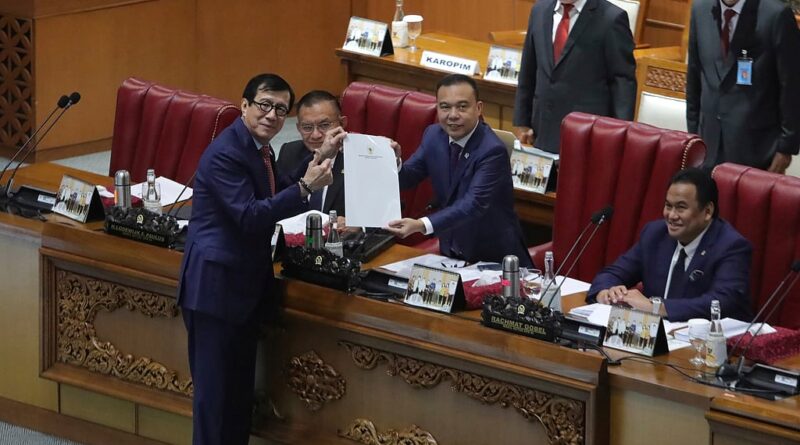
A parliamentary taskforce finalized the bill in November 2022 and lawmakers unanimously approved it a month later in what the government called a “historic step.”
Deputy Law Minister Edward Hiariej has defended the reforms as a modernization effort that shifts Indonesia’s criminal justice paradigm toward corrective, restorative and rehabilitative justice.“The new criminal code prioritizes repairing harm and social reintegration, rather than relying solely on punishment,” Hiariej said during a briefing on the new penal code on Thursday, adding that these principles reflect values long embedded in Indonesian society.Rights groups remain skeptical. Human Rights Watch warned the morality-based provisions could lead to invasions of privacy and selective enforcement.
The code also restores a ban on insulting a sitting president or vice president, state institutions and the national ideology. Cases must be reported by the president and carry penalties of up to three years in prison for “attacking the honor or dignity” of state leaders.This overreaching criminal code will entrench obstacles to freedom of speech while criminalizing legitimate and peaceful dissent,” Hamid said, warning it could open the door to abuse of power.
The new code also expands an existing blasphemy law, maintaining prison sentences of up to five years for deviations from the core teachings of Indonesia’s six officially recognized religions. It preserves penalties of up to 10 years for associating with Marxist-Leninist organizations and four years for spreading communist ideology.The revised code retains the death penalty, despite calls from rights groups to abolish capital punishment. However, it introduces a 10-year probationary period, after which death sentences may be commuted to life imprisonment or 20 years if the convict demonstrates good behavior.
It also maintains a ban on abortion while formalizing existing exceptions for life-threatening medical conditions and pregnancies resulting from rape, provided the fetus is less than 12 weeks old.This is a legacy of the law of retaliation,” he said, contrasting it with modern systems that emphasize harm repair and reintegration.
The Institute for Criminal Justice Reform said the code expands non-custodial sentences, including community service and supervision, and gives judges greater discretion to tailor penalties.
ICJR executive director Erasmus Napitupulu said these measures could help ease prison overcrowding and better serve victims.
Hiariej said the government has issued strict guidelines distinguishing criticism from criminal insult, but rights advocates argue the provisions threaten freedom of expression
Alongside the KUHP, Indonesia is also preparing a new criminal procedural law, or KUHAP, aimed at addressing procedural inefficiencies and strengthening human rights protections. Together, the reforms represent a comprehensive overhaul of the justice system, Hiariej