
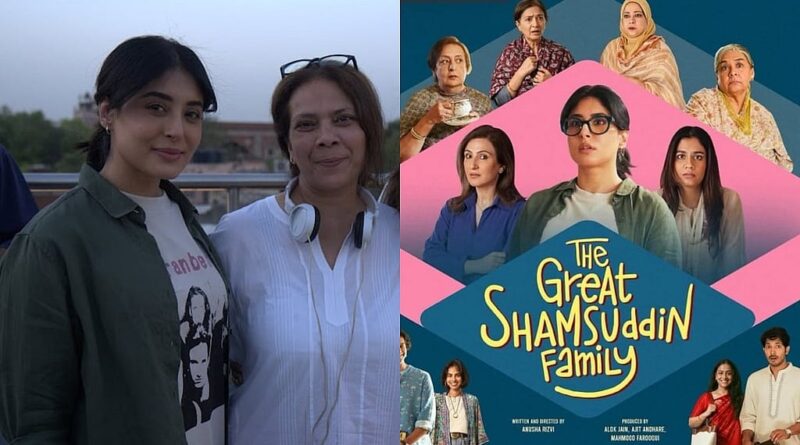
The Great Shamsuddin Family actor Kritika Kamra: I have to agree with the film’s politics, not my character’s
In Peepli Live (2010) director Anusha Rizvi’s recent sophomore release The Great Shamsuddin Family (currently streaming on JioHotstar), the protagonist Bani Ahmed (Kritika Kamra) has to finish a presentation for a job prospect. But that’s a macguffin. What we really get into is a heartwarmingly-hilarious comedy surrounding a Muslim family, which doesn’t shy away from commenting on the world it inhabits. A newspaper article, which Bani reads, talks about an FIR against a writer. The opening shot of the film has a vision of the Quran and also of George Orwell’s dystopian classic, 1984. A fears that her husband might have been lynched, and a young Muslim boy brings home a Hindu girl to marry. For most of its part, The Great Shamsuddin Family is another crisis-comedy, a laugh riot full of confusion, but it knows where the laughter stops.AR: To a certain extent, yes. Because, when you start writing a character there are some real-life inspirations you begin with. But as the story progresses the motivations have to be padded up. For Shamsuddin… and also for Peepli characters started from an actual space but eventually they moulded as the film’s plot progressed.
This film is a comedy-drama and at the centre of it there is a Muslim family. For a lesser film, this Muslim identity could have been incidental, but you go deep into the experience of being a minority in a polarized environment. What was your approach on peppering AR: See, when I decided to write the story of Bani Ahmed, who happens to be a Muslim, then automatically you also have to tell the story of her identity and her location in society. In the process, you will also have to discuss the time that she lives in. It was organic and it would have been dishonest for me as a writer to not address that.Kritika, before choosing a project, how important is the politics of a film to you?
KK: It is very important, especially how it treats its women characters, or what it is trying to say about the world. I have to agree with the politics of the film, not necessarily of the character I am playing. Infact, I would go on to say that the filmmaker’s politics is also secondary. But then in art, personal is political, so the director’s political viewpoint will eventually become a part of the movie. The film, thus, has to be about something I don’t vehemently disagree with.
In a conversation with the film’s director Anusha Rizvi and lead actor Kritika Kamra, we pick their brains on formulating the everyday comedy of the film, its politics, and whether it was easy to get a green signal for a movie about a Muslim family at the centre.Anusha Rizvi (AR): I take a lot of humour from daily observations. Like we have a scene in the film where the marriage registrar has had a heart attack. Now, the funny part comes in when we start thinking what happens to those 30-odd couples who were waiting—probably after eloping from their houses and hiding from their families—to get their marriages registered by this person. I feel India is such a place that even without trying, you find situations which are so absurd, yet so real.