
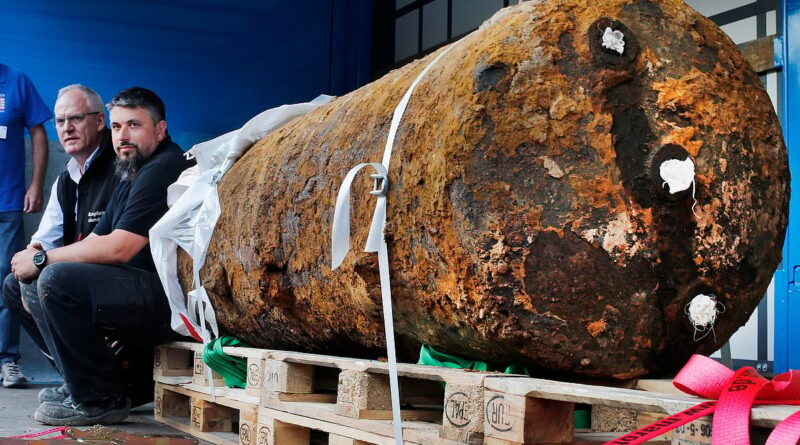
European wildfires reveal a hidden danger: buried bombs and mines from WWI and WWII
ELSENBORN: The wildfires burning across Europe this summer have exposed a potentially deadly threat lurking beneath the blackened landscape: rusty bombs and mines from World War I and II that threaten crews responding to the flames.
Some of the weapons have exploded in the intense heat. Blasts have been reported in France, Belgium, Germany and the Netherlands, where a bomb-disposal team was dispatched to check a forest threatened by flames near a site of fierce fighting in the Limburg province in 1944.Fueled by climate change, the fires and explosions show that the continent’s “climatic luck” is running out, said Sarah Njeri, a peace and conflict scholar at London’s School of Oriental and African Studies. Steady temperatures and predictable rainfall once ensured that most buried weapons stayed dormant.In a forest in tinder-dry France, a massive wildfire outside the southwestern city of Bordeaux uncovered a cache of what is believed to be World War II-era ammunition.
In the eastern Belgian province of Liege, Gov. Hervé Jamar said “a few sporadic detonations” were recently heard and that emergency services were adapting to account for munitions buried in a fire area. He said no fire crews were in danger, but local media published photos of a firefighter handling a rusted bomb.When you go into a forest like this, you are not sure where the explosives are,” he said. He remembers his father detonating a found bomb in a quarry.
The fire in the High Fens, which stretches across the border with Germany, is smoldering atop a much-bloodied battlefield where Nazis fought Allied troops. The Battle of the Bulge was fought in and around the High Fens.
The fire is even closer to the sites of two lesser-known skirmishes along Elsenborn Ridge and in the Hurtgen Forest, which lasted 88 days and killed about 33,000 American and 28,000 German troops.Drought has also helped to lay the past bare by shrinking rivers and lakes to reveal old weapons.
In Slovakia, the Danube River fell and exposed two naval mines that police pulled out of the water and buried in a trench for a controlled demolition. Authorities in Hungary closed Budapest’s Margaret Bridge after a bomb dating from World War II emerged at its base in receding water.
As the Rhine dried up, German authorities also found a WWII-era bomb.
During World War II, booby traps, bombs and mines were sprinkled throughout the province’s
“Climate change is now doing the work of unburying and reactivating what was previously stable,” Njeri said. Fires can ignite old munitions but can also burn away the scrub and brush that hides them.This wildfire season was supercharged by heavy rains in January that spurred vegetation growth, which became kindling when the summer heat arrived. Those temperatures, combined with drought conditions, low humidity and stiff winds, offered an ideal environment for fire, according to a study issued last month by the World Weather Attribution group.