
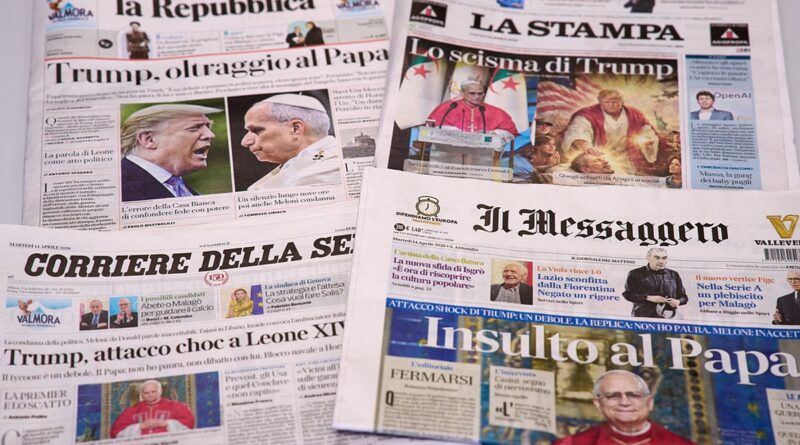
Trump’s exchange with Pope Leo reflects deep-rooted tensions between the Vatican and the United States
US President Donald Trump and Pope Leo XIV, the US-born head of the Catholic Church, had an unusual and acrimonious public exchange over the weekend.
In a the social media platform he launched in 2022, Trump accused the pope of being “WEAK on Crime and terrible for Foreign Policy.” The lengthy post on April 12, 2026, told Leo to “focus on being a Great Pope, not a Politician.”
Later that night, Trump adding, “I will continue to speak out loudly against war, looking to promote peace, promoting dialogue and multilateral relationships among states, to look for just solutions to problems. Too many people are suffering in the world today. Too many innocent people are being killed. And I think someone has to stand up and say, ‘There’s a better way to do this.’”
The public nature of Trump’s criticism may feel unprecedented. But there have long been tensions between the United States and the Vatican’s effort to seek peace, as scholars writing for The Conversation have shown in past articles.During the 19th century, when large numbers of Catholics immigrated to the US, they were looked at with suspicion. Some Americans claimed that “Catholics maintained allegiance to the church first and to American values and institutions second,” Mislin explained.Faggioli, a professor at Trinity College Dublin, wrote in the lead-up to Francis’ trip to the United States. That visit reflected “a story about change in religion and politics,” he noted – about relations between the papacy and the Catholic Church, on one side, and the United States, on the other.
Francis addressed Congress on this trip, which, according to Faggioli, “would have shocked most Americans only 30 years ago.”
He also noted how much world Catholicism had been influenced by American ideas in recent years, becoming “much more American than it used to be – and much more American than ItalianThe sacred must not be instrumentalised by the profane,” Francis stated in Kazakhstan in 2022. In other words, religion should not be a tool in the hands of the powerful. Francis also made constant appeals for peace amid the Ukraine and Gaza wars, though he avoided direct condemnation – which, at times, led to some criticism.
Even so, as D’Angelo said, it was “another major transformation” in how the church related with political power.
“Anti-Catholic cartoons suggested that Catholics would use political power to dismantle the nation’s institutions,” he added.
It was once “unthinkable” for American presidents to be seen with the pope. Dwight Eisenhower became the first US president to visit the Vatican in 1959.