
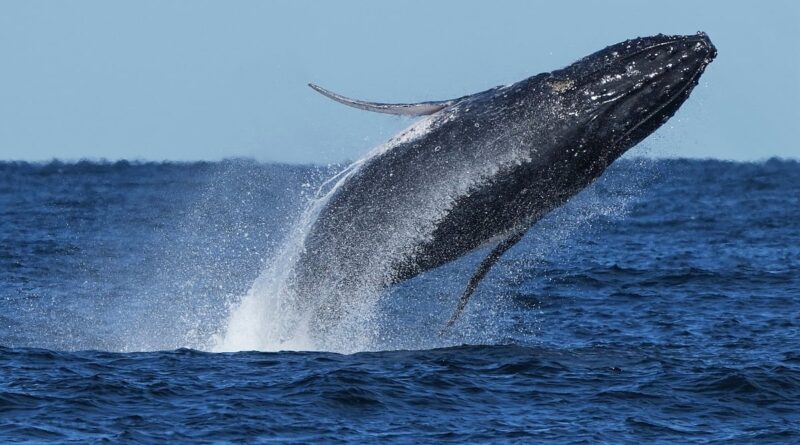
Whale ‘supergroups’ show numbers are rebounding from hunting, but Iran war holds dangers for them
CAPE TOWN: A South African couple found themselves in a rare situation when they witnessed a humpback whale “supergroup” consisting of nearly 300 of the giant marine mammals gathering together.
It’s an indication, scientists say, of how some whale species numbers have strongly rebounded in the southern hemisphere oceans decades after an international whale hunting ban came into effect in 1986.
Chris and Monique Fallows said they were used to seeing bigger and bigger groups of humpback whales off the west coast of South Africa but weren’t prepared for what they saw onemorning last December. Plumes of whale breath and spray burst into the air one after the other from blowholes, and the husband and wife found their boat in the midst of what’s known as a supergroup.
“It was extraordinary,” said Chris Fallows, a renowned fine art wildlife photographer who has documented marine animals for 35 years. “Quite quickly we realized that there must be several hundred whales coming together in one particular area.”
He said what they saw can best be described as a “Manhattan skyline” of whale breath plumes.It appears to be the biggest group of humpback whales sighted, according to Alex Vogel, the Africa coordinator for Happywhale. That organization has a global database of whales built off photos and information sent in largely by what it calls “citizen scientists” — ordinary people who capture images of whales that are then verified.
The organization did a count of the group that the Fallows came across.
Humpback numbers have strongly recovered in the southern hemisphere from less than 10,000 at the height of whaling to more than 100,000 whales now, according to assessments by scientists and the InternationalWhaling Commission, which monitors whale numbers.
Only a few countries still hunt whales commercially.
Humpbacks are generally solitary or move in small pods, but they sometimes gather in supergroups in food-rich areas. They feed on krill or small fish.Els Vermeulen, the chief scientist at the University of Pretoria’s Whale Unit in South Africa, said humpback supergroups started to be seen again around 2012 and it’s likely a result of their recovery from whaling.
“In general, the moratorium on whaling can be classified as one of the strongest conservation success stories in the marine environment,” said Vermeulen, who has a doctorate in zoology.
Vermeulen said that humpbacks feeding in supergroups make underwater sounds that attract other whales.While humpbacks have seen the biggest comeback from whaling, the World Wildlife Fund says the recovery has been mixed for other whale species and that various threats remain, like entanglement in commercial fishing equipment, collisions with ships and climate change.
Seven out of the 14 great whale species are classified as endangered or vulnerable by the International Union for Conservation of Nature, including the critically endangered North Atlantic right whales, which number only around 380 now.